In this article
Dementia care at Forest Place in one paragraph
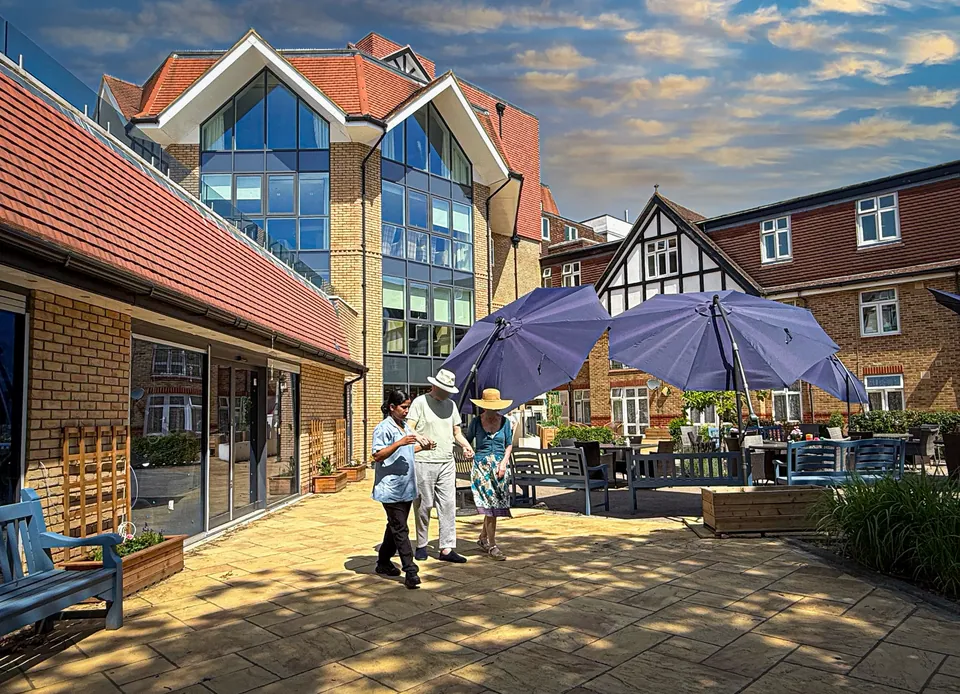
Forest Place is a 120-room nursing home in Buckhurst Hill with registered nurses on duty around the clock and two care units, Stradbroke and Meadway. The two units give some choice about where a person with dementia lives, and it is worth asking how that could change as their needs change. The grounds border Epping Forest and include a secure courtyard.
Residential dementia care or nursing dementia care?
This is the first thing to settle, because it decides which homes are even suitable. A residential dementia home has care staff but no nurses on site; medical needs are met by district nurses and the GP visiting. A nursing home with dementia care, which is what Forest Place is, has nurses on every shift. The difference matters when dementia is combined with diabetes that needs insulin, a history of strokes, Parkinson's, swallowing difficulties, pressure sores or a recent hip fracture. It also matters at the end of life, because a nursing home may be able to manage symptoms without a further move to hospital.
If your relative has been told by a hospital or a social worker that they need "nursing dementia" or "EMI nursing", they need a home like this one. If they have been told "residential dementia", a nursing home is still an option and avoids a later move if their health declines.
Why two units matter
Dementia does not stay still. The person who arrives walking, talking and joining activities may later need hoisting, help with every meal and a quieter environment. At Forest Place there are two units, Stradbroke and Meadway, each with its own team. Ask which unit would suit the person now, and how a change of unit would be discussed with the family.
Our advanced dementia care service covers the later stages: people who no longer communicate in words, who need help with swallowing and positioning, and whose distress has to be read from expression and behaviour. Where assessed needs call for constant reassurance or supervision, one-to-one care can be agreed for set hours.
What daily life looks like
A steady routine helps. Calm mornings, familiar rituals and fixed points in the day give people with memory loss something to hold on to. The team supports communication, nutrition, mobility and personal care as abilities change. Ask to see a mealtime when you visit, because how help is given at the table tells you a lot.
The grounds matter too. Time outdoors can ease the restlessness of being indoors all day, and Forest Place has a courtyard garden, with grounds bordering Epping Forest. Ask how residents get outside and who goes with them. Ask about visiting times as well, and whether relatives can join activities or meals.
Questions to ask any dementia care home in Epping Forest district
- Are there registered nurses on every shift, including nights?
- If my relative's needs increase, will they have to move home, or can they move within the home?
- Can residents get into the garden without a staff member unlocking a door?
- How is distress managed, and how often is medication reviewed with the GP?
- Is there a current CQC report, and what did it say about dementia care specifically?
- What happens at the end of life: can the home manage it, or will my relative go to hospital?
- How are families told about falls, infections and changes in condition?
Any home should be able to answer these on a visit. Forest Place's CQC registration and latest report are published on the Care Quality Commission website, and we will talk through them with you.
Funding dementia care in Essex
Dementia on its own does not qualify a person for NHS funding. What counts is the intensity and unpredictability of their needs. Anyone in a nursing home who is assessed as needing a registered nurse receives NHS-funded nursing care, a weekly contribution paid to the home. A smaller number with severe needs qualify for NHS Continuing Healthcare, which covers the whole fee. The balance is means-tested by Essex County Council, or by Redbridge for Woodford Green and Wanstead, against the 2026/27 capital limits. Our guide to discharge and funding sets this out in detail.
Visiting Forest Place
We are on Roebuck Lane, Buckhurst Hill, IG9 5QN, near Buckhurst Hill station on the Central line and close to the A104 and junction 5 of the M11. Visits can be booked through our tour form or by calling 020 8505 2063. Bring the person if you can, and watch how they react to the building, the staff and the garden.
Key facts
- Forest Place provides nursing dementia care, including advanced dementia care, with nurses on every shift.
- Two care units, Stradbroke and Meadway, each with its own team.
- A courtyard garden, with grounds bordering Epping Forest.
- Serves Buckhurst Hill, Loughton, Chigwell, Epping, Theydon Bois and Woodford. Call 020 8505 2063.
Where to go next
Sources: Alzheimer's Society · Dementia guide (NHS) · Care Quality Commission · Essex County Council
A question about care? Our team is here to help.
Talk to our team